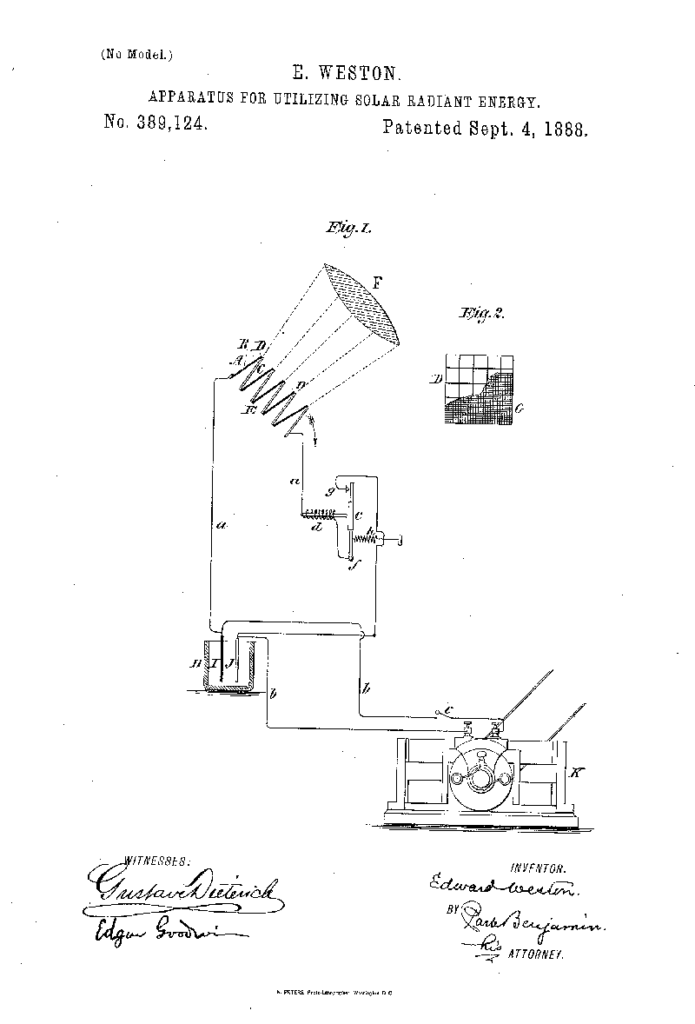
It all began with Edmond Becquerel, a young physicist working in France, who in 1839 observed and discovered the photovoltaic effect— a process that produces a voltage or electric current when exposed to light or radiant energy. A few decades later, French mathematician Augustin Mouchot was inspired by the physicist’s work. He began registering patents for solar-powered engines in the 1860s. From France to the U.S., inventors were inspired by the patents of the mathematician and filed for patents on solar-powered devices as early as 1888.
In 1883, an American inventor named Charles Fritts developed the first solar cell, using selenium as a semiconductor. The electrical efficiency of the cell was less than 1%, and the use of selenium made it very expensive, but it’s the first instance of successful conversion of sunlight into electricity. The first rooftop solar array using this technology was installed in New York City the following year.
Unfortunately, the industrial revolution was in full swing at this point, and 1884 also saw the invention of the modern steam turbine. This fossil fuel-burning invention outclassed early solar technology in both the amount and cost of energy it produced, and it went on to become the dominant energy technology that powered the 20th century.
Solar was largely ignored for its potential as a major source of energy through the subsequent decades. That changed with the dawn of the space race.
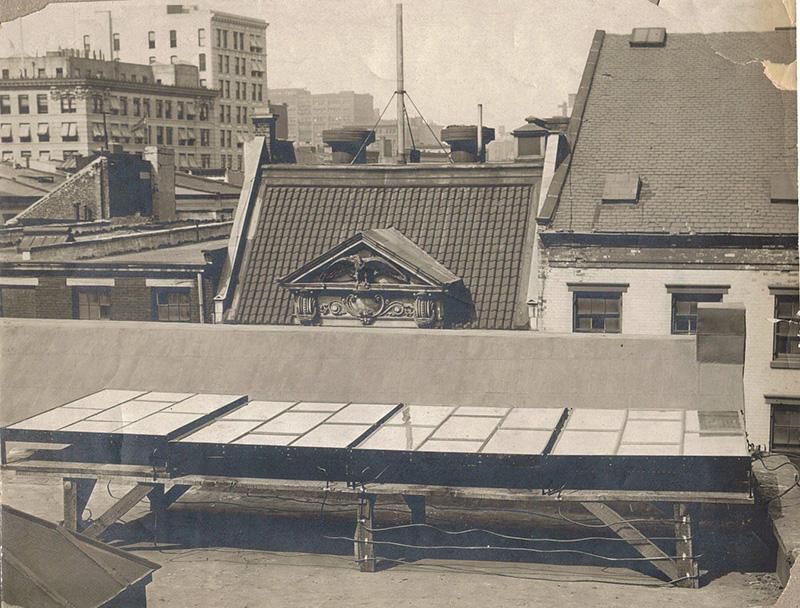
Charles Fritts installed the first solar panels on New York City rooftop in 1884.